One of the hallmarks of Indian economic recovery post-covid is that consumers are upscaling from plain vanilla to premium products. The growth rates in SUVs in the auto industry have been faster than those of entry level cars, premium varieties of tea are growing at three times the pace of normal varieties. In this series, one can find stories across corporate results indicating consumers shift to better products as the per capita income improves across the board.
This is also reflected in the food consumption pattern as can be inferred from the sub-categories of food inflation in India. Pulses and Vegetables have consistently contributed to higher inflation numbers as demand for them has increased faster than the acreage of their cultivation driven by upward mobility in income levels.
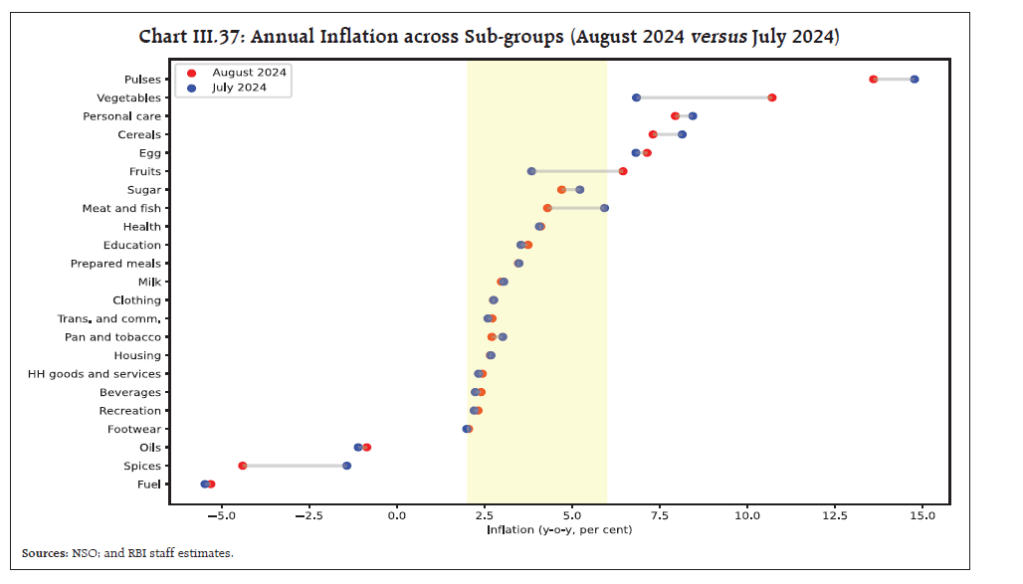
Which brings us to the question that we should be ready to augment farm incomes to higher levels encouraging them to grow more pulses, vegetables, fruits and diversify income sources from just rice and wheat.
This is a long road ahead where one has to traverse using past Indian farming methods instead of blindly copying Western mechanical agriculture. Narayana Reddy ‘Narayana Reddy | Unsung‘ one of India’s most well-known organic farmers whom I had the joy of listening to 7 years ago says :
“In the west, farmers are proud to say they are farmers. And yet, here, we seem to feel inferior. The city dwellers seem to think we are stupid. Why is that? If you ask me, the best profession is farming – there is no subordination; we work independently, we are at nobody’s mercy, we are our own masters. We are ‘sons’ of the soil, not land ‘lords’…. In my view, farming is the best profession – we can make profits of 24 percent.
I can prove that to you. I didn’t spend on tractors. Tractors disturb the structure and the efforts of the microorganisms is lost. The earthworms, the termites and the ants enrich the soil for us and rehabilitate the topsoil in 1 week. I use bullocks and a yoke which cannot go beyond 3-4 inches and hence don’t disturb the work going on below the topsoil. In 1g of topsoil there are over a million microorganisms. Today, in one acre of conventionally farmed land, there is less than 1 percent, thanks to chemical use. Healthy fertile topsoil is rich in minerals and contributes to good health. I don’t use pesticides or weedicides. There are 150 pests but the pesticides don’t target them alone. We have lost 15 species of valuable greens that grew among the weeds; they were full of medicinal value. Frogs can eat thousands of insects and are effective pest control. “
The traditional Indian farms were multi-level where the first level would be a tall Coconut or Supari Tree, the next level a guava or a chikkoo tree followed by shrubs usually pulses and the crop usually traditional varieties of rice or wheat or millets and even the grass having medicinal herbs. This alongwith many farm animals offering dairy products. We have to move back to that kind of a model for farm incomes to become more robust.
Akshayakalpa ‘Keeping our promise of purity since 2010! Akshayakalpa Story‘ is one of the startups that has taken steps in that direction. It started as an organic milk company more than a decade back and has now started a host of other products from their farms : I am already subscribing to palak and veggies, coconuts, paneer, fruits like banana from their farm. And this comes alongwith the morning milk delivery leaving a lower carbon footprint.
Hope many other start-ups embrace this approach connecting rural communities with urban consumers helping premiumise farm income in the same way corporates have been able to premiumise their products.
It is a long road ahead with significant investments needed in food processing, cold storage and warehousing facilities where the private sector has to step in with a larger footprint, helping farm incomes also rise along with the trend in urban per capita income!

 positivemindset
Leave a comment